
Five ways to protect our insurance rights + Senator SRP calls the utilities' bluff
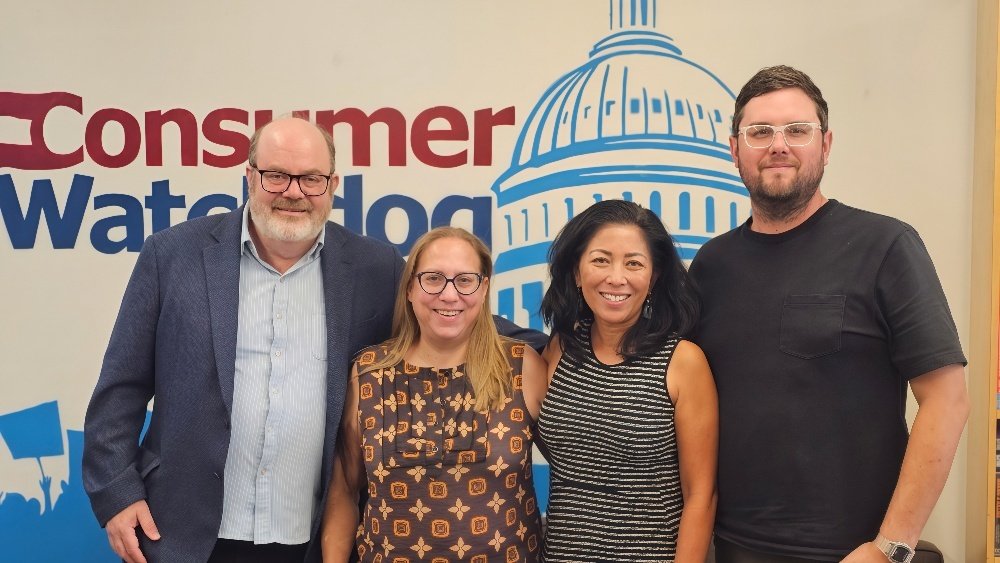
From left: Our wonderful Consumer Watchdog partners Jamie Court and Carmen Balber, me, and my EFSN co-founder Matt Craig.
Action-packed today, friends. Five ways to help protect survivors’ insurance rights. Utility bailout frenzy and shenanigans galore. Thursday’s FAIR Plan webinar. And an eye-opening recap of our Edison compensation Q&A, with the full recording.
Dear friends,
January 7 marks two years since the fires. It also brings urgent deadlines and possible cutoffs. Let’s make sure we and our neighbors have what we need to protect our rights.
We’re analyzing the survey results and will share our launch plans as soon as they’re ready.
Meantime, we’re hard at work researching problems we can tackle through enforcement, action by our next insurance commissioner, or legislation in the new year.
Help us gather evidence. If you’ve faced any of the issues below, please fill out the relevant form and upload any documents you have. You’re welcome to redact personal information first. If you don’t, we’ll redact identifying information before sharing documents further.
1. ALE cutoffs | Is your insurer ending your housing benefits January 7?
Several survivors have received notices saying their temporary housing benefits (ALE) will end January 7, 2027.
For qualifying homeowners, California law provides at least 24 months of ALE, up to 12 more months for rebuilding delays beyond your control, and further six-month extensions for good cause. Extensions give you more time to use benefits within your policy limit. Renters’ coverage may differ. (Ins. Code § 2060(b)(1))
We’re exploring an urgent request for the Insurance Commissioner to recognize widespread rebuilding delays and enforce the extension requirements before families lose housing support.
Got a January 7 cutoff notice?
Tell us more and share your January 7 cutoff notice
2. Smoke damage | Did your insurer send a rebuttal report?
Some survivors who submitted independent industrial hygienist reports got back reports commissioned by their insurers disputing the findings. Some say the insurer’s hygienist never visited their home and parts of the rebuttal look like they came from a template.
Insurers must investigate claims thoroughly and fairly and explain the facts and legal grounds for denials. (10 CCR § 2695.7(b)(1), (d) and CDI Bull. 2025-7)
We’re collecting rebuttal reports to see whether patterns warrant investigation, enforcement or legal action.
Got a rebuttal report?
Upload the report so we can identify patterns
3. Post-fire premiums | Are you still paying to insure a house that burned down?
Your house is gone. So why are you still paying to insure it as though it were standing?
After a total loss, insurers must consult with homeowners at renewal and adjust coverage and premiums to reflect the changed risk while they rebuild. The law also provides cancellation and renewal protections, with exceptions. (Ins. Code § 675.1(a)(1)–(3))
Survivors tell us those conversations and adjustments aren’t happening. Many worry that asking for a lower premium could put future coverage at risk. We’re looking at how to enforce existing protections and whether new legislation could set clearer standards.
Still paying to insure a house that burned down?
Tell us more
4. Mortgage-held funds | Can you get your insurance money to rebuild?
You finally get your insurance settlement. Then your mortgage company won’t release enough to move your rebuild forward.
Under AB 493, enacted in 2025, lenders must pay at least 2% annual interest on insurance funds they hold for rebuilding or repairs. But interest won’t pay the contractor who needs a deposit now. (Civ. Code § 2954.85)
We’re exploring legislation to set clearer rules and deadlines for releasing funds.
Is your mortgage company holding up your rebuild?
Tell us what’s keeping you from getting your rebuild money
5. What other insurance challenge should we work on?
We’re also working on claim delays, denials and underpayments, insurers pulling out of communities, nonrenewals and underinsurance. What else is standing between you and getting home?
Tell us what insurance problem we should tackle next
Thank you for giving us the evidence we need to enforce existing protections and fight for the changes survivors need.
We look forward to hosting a special EFSN Insurance Town Hall to share the enforcement, regulatory and legislative actions we’re planning and seek your input.
Utility Bailout Shenanigans. Enter Senator Pérez.
Well, friends, all this is coming to a head.
For weeks, the word around Sacramento was that Edison and PG&E only wanted a special session to cut a deal on insurer subrogation.
Then this morning, L.A. Times investigative reporter Melody Petersen dropped a bombshell. The secret prize Edison and PG&E are seeking before Thanksgiving? A bailout demand so audacious no one will discuss the details in public.
A permanent cap on what their shareholders pay for catastrophic fires their utilities cause, even when their own negligence or misconduct is to blame.
Anything above the cap? Survivors and all Californians pick up the tab.
As the Times reminds us, PG&E pleaded guilty to 84 felony counts of involuntary manslaughter in the Camp Fire. Edison is still under criminal investigation for the Eaton Fire. Already, both utilities want lawmakers to shield shareholders from the costs of their next catastrophic corporate failure.
While their lobbyists twist arms behind closed doors, their CEOs are warning investors that customers could face delays getting electric service unless lawmakers give them a bailout in a special session this month.
On her earnings call, PG&E’s CEO laid out a $2 billion cut to its 2027 investment plan and said she expects to recommend another shareholder dividend increase. Apparently, there’s money for shareholders, but not for electricity service to new homes.
Outrageous? Yes. But all this may backfire.
Senator Sasha Renée Pérez just sent a scathing letter to the CPUC. Federal securities law prohibits public company executives from misleading investors, she points out. So take them at their word. If they say they can’t afford to serve Californians, treat it as the financial emergency they say it is.
Pérez wants the CPUC to enforce its little-known rules that put service first. Stop funds from flowing up to the parent companies so that money stays available to serve customers. If the utilities need more money to do their jobs, require their parent companies to send it down to their utilities.
That’s the bargain for monopoly service. These companies get the exclusive right to serve our communities. In return, they have to provide the service and put up the money to deliver it.
California already has rules that put Californians ahead of Wall Street shareholders. The CPUC must now enforce them. Californians need the safe, reliable electricity we paid for.
See the LA Times article detailing what Edison and PG&E are asking from lawmakers
Read Senator Pérez’s demand for the CPUC to crack down
This Thursday, November 5, 7–8 p.m. PT | FAIR Plan Webinar
Dumped onto the FAIR Plan: Your Coverage Gaps, Rights & Potential Claims
If you were pushed onto the FAIR Plan before the fire and now have a coverage gap, who may be responsible?
We’ll cover nonrenewals, notice rules, moratoriums, FAIR Plan and Difference in Conditions coverage, smoke damage, and current renewal protections.
Presenters
Renee Callantine, Corner Law
Dylan Schaffer, Kerley Schaffer
Save your free seat for Thursday’s FAIR Plan webinar and share with survivors and groups navigating the FAIR Plan.
SBA loan trouble? Meet with decision-makers this week only.
Eaton, Palisades and Malibu survivors, the SBA asked us to get the word out. This week, you can sit down in person with the people who have the authority to make decisions about your disaster loan and help resolve problems you’ve been trying to sort out by phone. The SBA told us this is their first and last visit of this kind during our recovery.
November 2–6 | 9 a.m.–5 p.m. | The Collaboratory, 540 W. Woodbury Road, Altadena
Homeowners, renters, businesses and nonprofits with SBA disaster loans, bring your loan information, correspondence and questions.
Edison compensation: We went looking for answers. We got them.
To be an Eaton Fire survivor these days is to be the target of a flood of mailers and ads from Edison promoting its WRCP. But how often have you had the chance to get answers from consumer advocates with deep experience in the arcane world of utility wildfire litigation? We went straight to two of California’s leading experts for a special two-hour Q&A.
Jerry Singleton and Amanda Riddle are two of the three court-appointed liaison counsel coordinating litigation involving 50,000 plaintiffs and more than 700 lawyers representing Eaton Fire survivors. Their fellow lawyers elected them to help organize the litigation and serve as their point of contact with the judge.
Jerry has handled three dozen California utility wildfire cases since 2007. Eaton is Amanda’s 14th.
From how much survivors could receive to how soon we could be paid, what we heard was eye-opening.
Does litigation mean waiting six or seven years? Jerry doesn’t expect it to. Utilities have historically agreed to mediation as trial dates approach. He said as the evidence against Edison is overwhelming, mediation preparations are already underway. Based on prior fires, he expects most Eaton cases to resolve in 2027 or 2028. WRCP payouts could follow a similar timeline, especially for families with children, whose claims require a separate process that can add three to six months before payment.
Is the WRCP really “the most generous utility program in history”? Edison is comparing its program with the two previous programs utilities have set up on their own, after the Dixie and Mosquito fires. Jerry said those paid an average of 10–20 cents per dollar of actual damages and estimates Edison’s WRCP pays 30–50 cents per dollar. Most utility-fire settlements are negotiated through mediation with advocates on both sides. That’s the route most Eaton plaintiffs are expected to take, and those settlements are a separate comparison.
Insurance deductions can make a huge difference. Negotiated settlements deduct insurance payments you’ve actually received. The WRCP deducts available coverage, including money you haven’t received. That’s a huge distinction if you’re still fighting delays or underpayments.
What about renters and smaller claims? Edison features a renter case study showing more than $600,000 in compensation. Amanda said none of the renters she represents has received an offer that high. Both speakers said renters and people with smaller claims can find attorneys, depending on their circumstances, including emotional losses and proximity to the fire.
Could the WRCP make sense for some people? Yes. The speakers gave the example of a renter with no insurance, few belongings and little or no emotional distress. They urged survivors to talk with an attorney who can assess their losses before deciding.
What are the deadlines? January 7, 2027 is a critical filing deadline for personal injury and emotional distress claims. Edison’s November 30 WRCP deadline is separate. Finding an attorney and preparing a lawsuit take time, and the holidays are coming. Don’t wait for Edison’s offer to hire an attorney. Waiting could leave you without enough time to file and preserve your claims.
Trial update: The Pasadena Star-News reported yesterday that the judge denied Edison’s request for a six-month delay, so things are now happening fast. Trial is set to begin in early March.
This is just a glimpse of our two-hour conversation. If you’re weighing your options, watch the replay now, while you still have choices. For some families, understanding the difference between these paths could mean hundreds of thousands of dollars.
Weighing an Edison offer or a lawsuit? Watch the full Q&A
Around the Community
November 14–15 | Volunteer for the Every Standing Home door-to-door campaign
Give 2½ hours to help EFRU and Surviving Structures Eaton Fire Recovery reach neighbors with information about smoke contamination. You’ll go door to door in pairs. Learn more and register.
November 14 | Second Annual State of Black Dena Homecoming
Join generations of Black Altadena and Pasadena from 11 a.m. to 5 p.m. at the Eaton Fire Collaborative to reconnect, celebrate the community’s history and shape what comes next. Learn more and register.

What’s YOUR favorite way to vote?
Me, I’m Team Drop Box all the way. But to each their own! Find all the ways and places to vote.
My husband and I enjoyed voting with help from the nonprofit, nonpartisan CalMatters voter guide.
Polls close at 8 p.m. tonight.
And then we wait for results. Let’s hope it’s days and not weeks.
Have a good one, friends!
Joy