
Spicy and Caffeinated in Sacramento
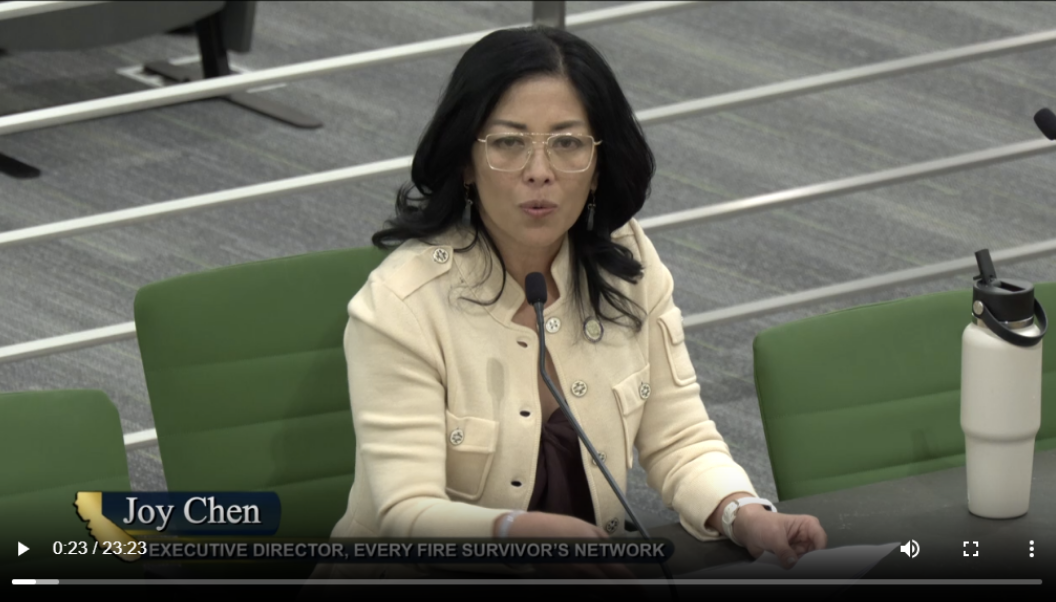
EFSN Executive Director Joy Chen on the California Sena Floor
Dear friends,
I'm back from Sacramento, and I have a lot to report.
Last week, I testified at the first state hearings since January 2025 to take on the big questions of wildfire recovery in California:
Who pays?
Utilities? Their shareholders? Insurance companies? Survivors?
The hearings centered on the SB 254 Study, the 130-page report on wildfire recovery policy that will shape the omnibus wildfire bills expected this summer. I read it so you don't have to.
But first, thank you.
After my Wednesday dispatch about things getting spicy in Sacramento, the flood of messages from you carried me through the week. The chili pepper emojis. The “I love spicy!” posts. The running commentary about which legislators clearly heard us and started grilling the industry.
It reminded me that we are in this together.
What happens in Sacramento over the next few months is going to shape whether tens of thousands of families across Los Angeles ever truly recover.
What I Said in Those Rooms
I told legislators the reality survivors are living right now.
According to the Department of Angels, 7 in 10 survivors are still not home. Nearly half have depleted significant savings, and 43% have taken on debt. Many of us are running out of housing coverage while fighting delayed insurance claims.
And the for-profit company which caused the Eaton Fire?
Record profits.
In 2025, Edison's profits tripled from $1.3 billion to $4.5 billion.
CEO Pedro Pizarro's compensation rose to $17 million.
They increased shareholder dividends to over $1.3 billion.
Who's paying for all this corporate excess?
The same displaced families now maxing out credit cards trying to stay housed.
Here's what I told legislators:
“If the financial rewards for repeated catastrophic failure are record profits, record executive pay, and record shareholder dividends, then catastrophic failure is exactly what this system will continue producing.”
My written remarks to the Senate and Assembly Utilities Committees.
My written remarks to the Senate Emergency Management Committee.
Watch the Hearings
If you want to understand where California disaster policy is heading, watch these hearings.
Very little of this debate is covered publicly. That's exactly why we need to pay attention.
Senate Utilities and Energy Committee
(skip to 2:01:00 for my testimony and following my panel, the discussion chaired by Senator Ben Allen)
Assembly Utilities and Energy Committee
(I speak at 59:01, followed by an extended discussion with the SB 254 study authors, utility executives, and counsel)
Senate Emergency Management Committee
(I speak around 1:45:50)
Two moments especially stayed with me.
1. During the Assembly hearing, a legislator asked the study authors what “non-economic damages” means.
The RAND consultant answered: evacuation stress. Things like that.
What he failed to mention is that “non-economic damages” also means deaths. Pain and suffering. The destruction of entire communities.
And the SB 254 Study recommends capping what utilities owe for all of it.
2. Another thing worth knowing:
The RAND team that coauthored California's SB 254 Study on how utility accountability should work is the same consulting team Edison hired to design its own survivor compensation program.
You know, the program offering some smoke damage survivors $10,000 and all others $0, when remediation costs can reach hundreds of thousands of dollars.
And the other firm that testified on behalf of the SB 254 study, Aon?
Does Aon also work for Edison?
You read that right.
The consultants shaping the state's framework for regulating utilities are also being paid by the utility whose financial exposure is on the line.
Is it any coincidence, then, that throughout the hearings, the SB 254 Study coauthors consistently guided legislators toward further insulating these three for-profit electric companies from the consequences of their repeated catastrophic fires while shifting more of those costs onto Californians?
RIP: Wildfire Safety Audits
The day after the hearings was what Sacramento insiders call “Kill Bills Day.”
That's when appropriations committees quietly kill bills special interests find inconvenient, away from the public eye.
Assembly leadership killed AB 1774, the bill requiring independent audits of the $9 billion that the three for-profit utilities collect annually from ratepayers for wildfire mitigation.
This is despite Los Angeles Times reporting that Edison collected roughly $500 million for mitigation work in the four years before the Eaton Fire that was never actually completed.
If AB 1774 had been law, the Eaton Fire might never have happened.
Just last month, AB 1774 passed committee unanimously, 11-0.
Then was quietly shivved in the darkness where democracy dies.
We will push to get independent audit requirements folded into the omnibus wildfire bills this summer.
Three Insurance Reform Bills Advance
Now for some excellent news.
All three of our insurance reform bills at fixinsurance.org have now cleared Senate Appropriations and are heading to the full Senate floor.
Indeed, survivors do have allies in Sacramento. There are legislators from both parties who truly care about consumers, want to stand with survivors, and are working hard to understand these complicated systems.
We need to keep bringing them strong ideas, clear evidence, survivor stories, and public support so they can advance meaningful protections.
Together with Consumer Watchdog, we are continuing to build support statewide.
Please Help Keep Our Survivor Hub Going
The utility and insurance lobbies are extraordinarily organized and extraordinarily well-funded. They have tentacles everywhere.
And they are fighting the consumer protections survivors urgently need.
Here's why this matters:
After prior California wildfires, only 38% of destroyed homes were rebuilt after eight years. The single biggest factor was whether insurance paid fully and on time, and when utilities were responsible, whether utilities compensated survivors.
Recovery follows the money.
That's why EFSN's work at the intersection of insurance accountability, utility accountability, and survivor coordination is so important. Unless we unlock the tens of billions still owed to survivors by insurers and utilities, many families simply will not be able to get home.
Generous new support of the California Community Foundation and Pasadena Community Foundation has helped us lay the foundation for Year Two. Now every additional dollar expands our ability to accelerate recovery for families across Los Angeles.
Every $1 invested in EFSN has helped generate more than $1,000 in delayed insurance funds deposited directly into survivor accounts.
And while we fight to improve systems, we also continue supporting survivors through the long road of recovery itself.
Our vision is a Los Angeles where no one faces disaster alone, and where the systems responsible for funding recovery work well enough that every family has a real shot at getting home.
If you share that vision, and if you are able to, please consider supporting our work.
EFSN Is Hiring
We are hiring for two part-time positions, approximately 20-25 hours a week to start, with the goal of transitioning into permanent roles as funding expands.
Project Manager
Lead our growing webinar programming and backend operations.
Apply here.
Marketing Manager
Support Sandra Stanisa and me on media coordination, social media, and public storytelling that keeps recovery in the public eye.
Apply here.
Both positions require 2+ years of experience.
We're also searching for a nonprofit accountant.
As a former executive recruiter, I believe the right people for these three mission-critical positions are already connected within our community.
Please think about who you know, and forward these on.
EFSN Webinar:
Behind the Pulitzer Prize
Wednesday, June 3· 7:00–8:30 PM
I am so excited for this one.
2026 Pulitzer Prize winners for Explanatory Reporting, Susie Neilson and Megan Fan Munce, will join us for a behind-the-scenes conversation on BURNED, the San Francisco Chronicle investigation exposing how insurers used flawed algorithms to systematically undervalue California homes, underpay wildfire survivors, and make rebuilding impossible for many families.
When I texted Susie to congratulate her on the Pulitzer, she wrote back that all of us at EFSN deserve a huge amount of credit because so much of the reporting came directly from survivors inside our Discord and from the 60+ survivors we connected to their reporting team.
I will be hosting Susie and Megan for what promises to be a fascinating look into what they uncovered, how they investigated it, and what questions they are still pursuing.
All Eaton and Palisades survivors and allies are warmly welcome. Register soon. This one may fill fast.
Jeff Prang Webinar Recording
Our property tax webinar with Jeff Prang was beautifully moderated by Palisades survivors Wendy Marantz Levine and Ian Wade.
The recording and slides are now available here:
Community Event: Who Gets to Come Back?
Thursday May 21 at 6:30-8:00pm - Online
Our partners at the Altadena Tenants Union are hosting an important conversation on the future for renters. New UCLA research shows that most rental units within the Eaton Fire perimeter still show no visible signs of rebuilding. Senator Sasha Renée Pérez will be part of the panel discussion. Spanish translation will be provided.
Register here: bit.ly/altadena-tenants
What a week.
The fights over insurance payouts and utility compensation are not abstract policy debates. They are the financial engines that will determine whether tens of thousands of Los Angeles families get home.
That's worth fighting for.
And honestly?
Somewhere between the chili pepper emojis, the caffeine, and survivors live-commenting legislative hearings like it was playoff season, Sacramento started becoming fun.
Hugs,
Joy
