
What happened at the UC wildfire summit? How do I put this delicately …
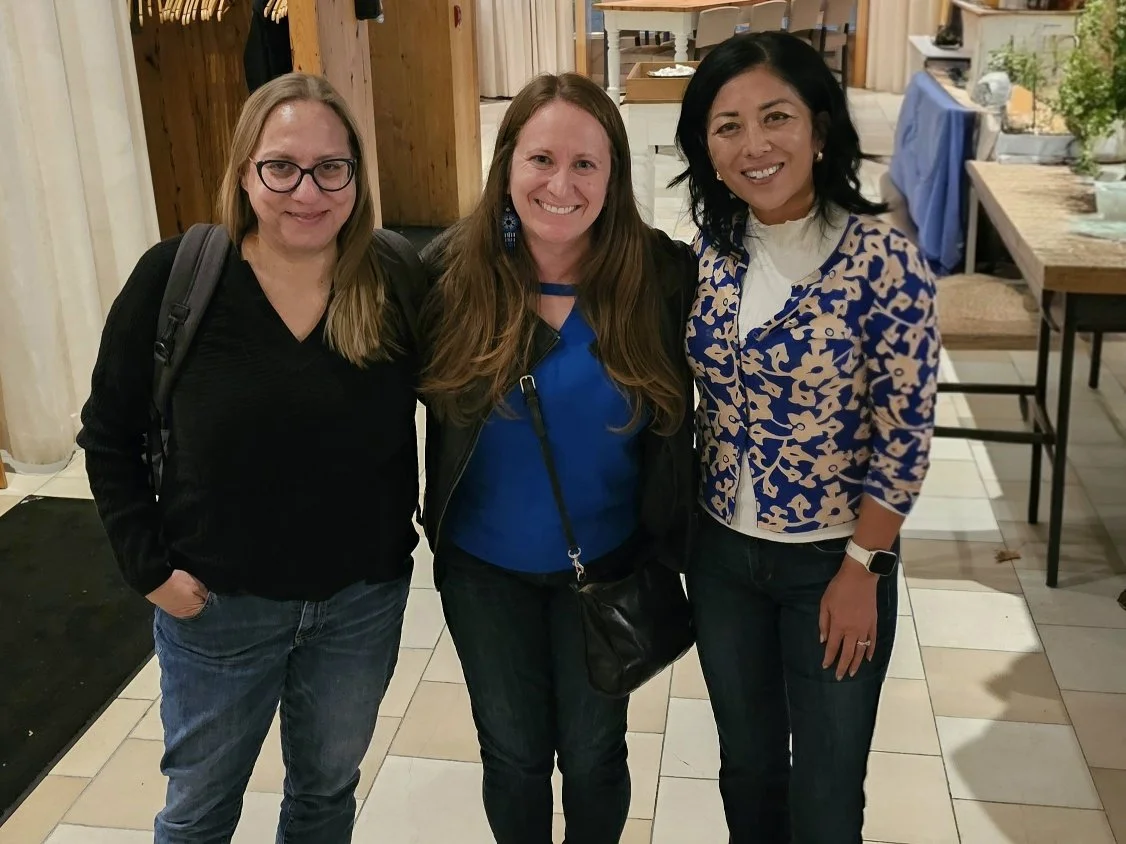
Dinner before the UCLA and UC Berkeley summit in Sacramento! Carmen Balber, Monica Embrey and me.
Dear friends,
Last week I told you I was headed to Sacramento to meet with powerful interests about the utility bailout.
Something shocking happened there. Afterward, I called a few other participants to see how they’d describe it. The consensus was that it was … how do I put this delicately …
A “total shitshow.”
UCLA and UC Berkeley had invited utility and insurance executives, government staff and advocates to a closed-door summit at the UC Student Center. I went because PG&E and Edison have caused three of the five costliest wildfires in Aon’s global ranking by insured losses, and Californians pay some of the highest electricity rates in the country. I wanted two of our great public universities to help answer an urgent question:
How do we get safer, more affordable electricity? Read our survivor-led proposal
The first clue things were about to go haywire
It was right there in the universities’ 24-page pre-read: The utilities were in financial distress! To help them, California had to act fast! Read the summit pre-read
They spent the first hour walking us through a revisionist history of how we got here. The Legislature had failed to protect the utilities. Their stock prices had fallen. It sounded like a history lesson written by Edison CEO Pedro Pizarro.
Remember what actually happened? Survivors, cities, counties and people across California told lawmakers what another utility bailout would cost us. Both houses listened. They killed the bailout.
That part dropped out of the history lesson. So did the years of unsafe decisions that saved Edison money while putting Californians in danger. Edison filed reports documenting safety work it had left unfinished. The California Public Utilities Commission had those reports for years. What did it do with them? Los Angeles Times investigation
If we don’t know what the dangers are, we can’t fix them. I’d sent the universities our survivor-led proposal before the summit. It calls for investigating who made those decisions, what regulators knew and what would actually make us safer.
Then the UC organizers put something on the screen.
The proposal that blew up the room
The UC team called it a “hypothetical strawperson.”
What did UC propose?
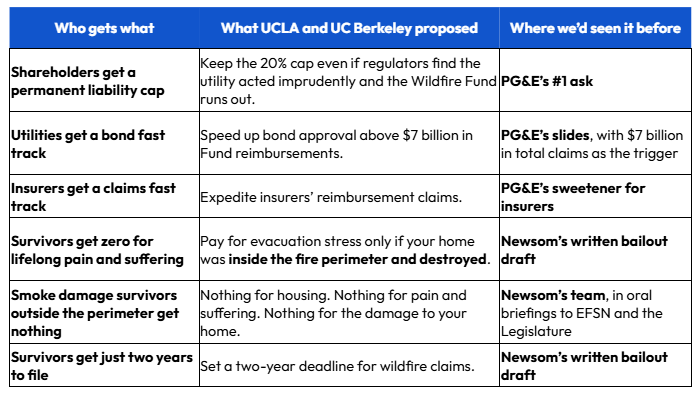
Cap what Wall Street shareholders have to pay. Fast-track reimbursements for insurers. Stick Californians with years of charges on our electric bills for fires the utilities cause.
Then cripple survivors’ chances of ever recovering. Give them just two years to file. Deny compensation for lifelong pain and suffering. And if your home was made uninhabitable due to toxic smoke contamination outside the fire perimeter? You get nothing.
Are you a Wall Street shareholder? Your investment just got safer!
Are you a Californian paying the electric bill or trying to recover from the next fire? Too bad, so sad!
People in the room were aghast. Someone immediately asked why this UC “strawperson proposal” hadn’t been in the pre-read or on the agenda. Someone else asked if it had come straight from Patti Poppe.
Then came the mayhem. The only people who defended it were utility and insurance lobbyists.
Twenty minutes later, the UC organizers withdrew the proposal and changed the agenda.
Afterward I called Consumer Watchdog’s Jamie Court, who always seems to know what’s going on in Sacramento. His first question was how closely the UC slides matched the confidential proposal PG&E and Edison have been feverishly shopping around the Legislature.
Melody Petersen had seen the PG&E slides and broken the story in the Los Angeles Times. Under the proposal, Edison’s shareholders would get a $4.3 billion cap. The rest could land on our electric bills. The story ran without the slides.
Of course Jamie had the PG&E slides. He also sent me Governor Newsom’s ultra-secret, 11th-hour August bailout draft. We put all three side by side.
Let’s shine some light on all this
Ever seen Newsom’s ultra-secret, 11th-hour bailout draft? Here it is. Newsom’s confidential draft
The secret slides PG&E and Edison have been in a frenzy shopping around Sacramento? Here they are. PG&E’s confidential slides
And where did those secret bailout terms finally go public? At the UC Student Center. Presented by UC employees. With PG&E shareholders’ #1 ask at the center of it all. UCLA and UC Berkeley’s slides
Read the full side-by-side comparison
As a 2x Bruin, I’m deeply disappointed by my alma mater. Every Californian deserves an answer:
Why did UCLA and UC Berkeley, two of California’s most important public institutions, make PG&E’s secret bailout proposal the starting point for discussion at their summit on wildfire liability?
California is not some banana republic where two electric monopolies get to decide whose interests our public institutions serve. UCLA and UC Berkeley belong to the people of California.
We welcome both universities back to the work we count on them to do.
Newsom’s thrown in the towel. PG&E and Edison are still lobbying.
Noah Baustin of POLITICO had all the scoops yesterday. Edison CEO Pedro Pizarro told investors November 15 was the deadline to get a deal through. That date came and went. Governor Newsom has finally said sayonara to the bailout. He’s leaving it to Xavier Becerra, who takes office in January. And Edison and PG&E are STILL pushing for a special session after new lawmakers are sworn in on December 7. Noah Baustin in POLITICO
Mark Toney of TURN told Noah why the bailout keeps failing.
“This behind the scenes, closed doors, released at the last minute, which is what we’ve done since 2019 with wildfire policy … I think that’s part of why it failed this time. People are tired of that.”
Here’s what I told Noah about why the UC proposal died in the room.
“The real problem for Californians is not how to shift liability off two companies that keep on burning down communities. The real problem is to identify what is going wrong. Why do two companies keep burning down communities?”
Assemblymember John Harabedian told Noah it would be “politically negligent” to rush through a shareholder cap outside a “grand bargain that actually solves the entire problem.”
“I just think that there’s a clear misreading of the situation here by the [investor-owned utilities],” he said. A short-term cap “would only make sense in the context of a transition to publicly-owned utilities.”
Yes. That’s the voice of democracy and sound public policy.
Help us gather evidence for insurance accountability
EFSN is gathering evidence to help Insurance Commissioner-elect Jane Kim’s office on issues survivors are facing. If your insurer is cutting off your housing benefits or has sent you a report disputing your smoke damage, we want to hear from you.
Is your ALE ending January 7?
We’re exploring the possibility an urgent action for the Insurance Commissioner to recognize widespread rebuilding delays and enforce the extension requirements before families lose housing support.
Got a January 7 cutoff notice?
Tell us more and share your January 7 cutoff notice
Did your insurer send you a smoke damage rebuttal report?
Some survivors who submitted independent industrial hygienist reports got back reports commissioned by their insurers disputing the findings. Some say the insurer’s hygienist never visited their home and parts of the rebuttal look like they came from a template.
We’re collecting rebuttal reports to see whether patterns warrant investigation, enforcement or legal action.
Got a rebuttal report?
Upload the report so we can identify patterns
What if our public institutions put Californians first?
In fact, the UCLA/UCB summit turned out to be a success for the people of California. When PG&E’s secret bailout terms finally appeared in public, the shit hit the fan in spectacular fashion.
The next time powerful interests try to sell us a bailout, they should remember those twenty minutes.
Now imagine what would happen if all our public institutions put that much energy into protecting Californians. We’d find out which decisions make the utilities money while putting us in danger, what regulators do with the warnings they get, and what would have prevented these catastrophes. Then we could change the rules so utilities make money by keeping us safe and delivering electricity we can afford.
And if two corporate monopolies don’t like those terms? Fine! We can change who owns and runs our electric system, too.
So many of us are still fighting to get home. Thank you for fighting alongside one another for our recovery and for a safer future for all of us. I’m so glad we’re in this together.
Love,
Joy