
Year Two Starts Now
Jan 9, 2026
Dear friends,
I’ve been asking survivors a question lately:
How have you grown as a result of this fire?
Here’s my answer:
I learned how to run a press conference.
Not the glamorous kind, filled with young women in short skirts holding walkie talkies.
The kind you do when there’s no budget, no staff, no PR firm, and the stakes are people losing their homes for good.
Before the fire, I’d attended plenty of press conferences over 30 years in leadership and public life. I had never led one. That changed last year, not by choice.
A few weeks after the fire, it became obvious that if insurers were going to be held accountable, someone needed to put survivors in front of cameras and tell the truth about delays, denials, and underpayments. I remember thinking: someone should do a press conference!
Then realizing that someone was going to have to be me.
I was a full-time unpaid volunteer. I had no idea what I was doing. I just got started.
Learning in public, where everyone can see you fail
From there, each press conference became an experiment. What worked. Reporters kindly helped by telling me what annoyed them.
We pivoted and iterated, and failed. (Yes, the livestream broke. Again.)
By now, I’ve led six or seven press conferences. Each one clearer, tighter, more disciplined.
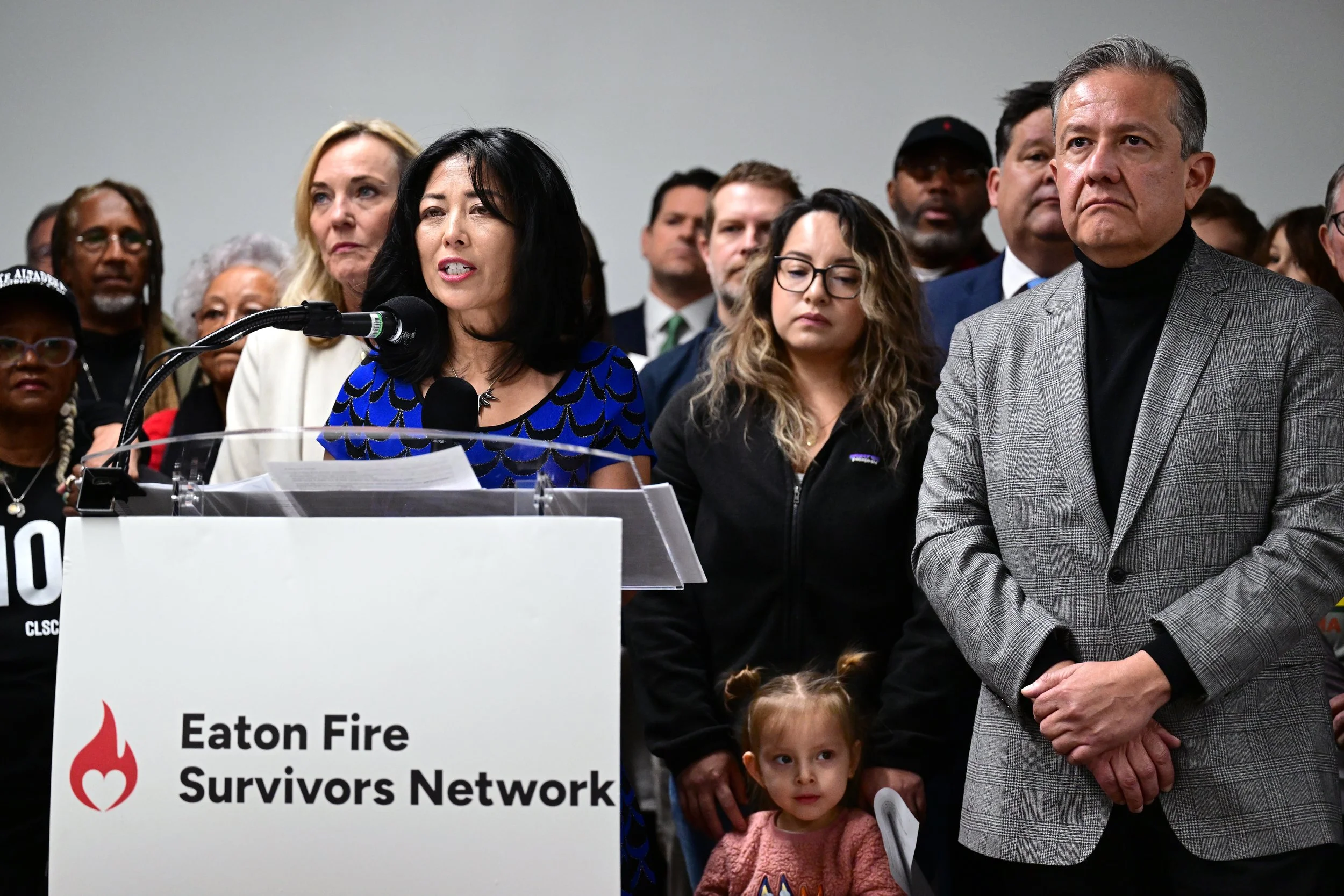
Still, the one-year anniversary felt different. There were many ceremonies, vigils, and remembrances across Eaton and the Palisades. Ours was the only press conference. That brought extra pressure to get it right.
Given the overwhelming grief surrounding us, I honestly didn’t know if I would start crying in the first minute and not be able to go on. I’ve always cried easily. That’s led to more than a few embarrassing moments in my career.
But that wasn’t the hardest part.
The hardest part was this question:
How do you tell the story of an entire year of loss, bureaucracy, resilience, exhaustion, and injustice for tens of thousands of people, do it coherently, touch both minds and hearts, and do it in a way that actually changes what comes next?
That question dogged me for months.
I spoke with survivors from California fires going back to 2017. I read the research. I sat with the data showing that eight years after those fires, only 38% of homes had been rebuilt.
The difference wasn’t grit or determination.
It was money.
Insurance payouts.
And when a utility was at fault, utility compensation.
What I learned was this:
Recovery follows the money.
Putting the truth on the record
Looking at the depth of data and analysis EFSN has done in just one year, it became clear that unless something changed, Los Angeles was headed down the same path.
So that became the backbone of our one-year anniversary survivor-led press conference:
Year One of the Eaton and Palisades fires produced a K-shaped recovery.
If you were wealthy before the fire, or one of the lucky few (like me), whose insurer paid fully and on time, recovery moved forward.
If you weren’t, recovery stalled.
Not because people lack grit or determination.
But because the billions needed for recovery have not yet come.
That is the truth we put on the record at the press conference.
What survivor leadership has already changed
We also shared something else. Survivor voice and leadership are already moving real money.
In Year One alone, survivors unlocked over $100 million in delayed insurance payments directly into the accounts of Eaton and Palisades families.
Not because insurers suddenly chose to stop harming families.
But because survivors organized, documented misconduct, and forced accountability.
That is extraordinary.
It is a testament to what happens when survivors stay connected and coordinated.
And it is still only the beginning.
What it will take to make recovery work
There are tens of billions more that must be unlocked if this recovery is going to work for everyone.
To do that, we need to grow even stronger together. We have to expand beyond the 10,000 survivors and allies we've already connected. And we have to work in close partnership with elected officials, nonprofits, and philanthropy to unlock what is owed from three places:
• The company whose negligence caused the Eaton Fire: Edison.
• The insurance companies that owe us the benefits we already paid for in full.
• And the federal government, which we pay taxes to and which has provided disaster relief to every other community facing catastrophe at this scale.
The truth about philanthropy
We also learned about philanthropy.
Many of us are alive because of it. We have chased $500 grants and $2,000 checks just to keep our families afloat.
But total wildfire philanthropy in the entire United States in 2023 was only $123 million.
Philanthropy is essential. It is also nowhere near enough to get everyone home.
Recovery at this scale requires tens of billions.
That money already exists. Catalyzing it is work we must do together.
The leaders and partners who stood with survivors
The clarity at our press conference came from the people who stood at the podium together.
• Christy Zamani of the Eaton Fire Collaborative Leadership Council shared what happens when disaster collides with an existing housing shortage, mass homelessness is the predictable outcome unless Edison advances urgent housing relief.
• LA County Supervisor Kathryn Barger spoke about launching the investigation that prompted State Farm to issue checks that allowed many families to begin rebuilding.
• Senator Sasha Renée Pérez announced new legislation aimed squarely at illegal insurance delays and underpayments.
• Assemblymember John Harabedian shared that he has initiated a state audit to understand what went wrong so these failures are not repeated.
• Miguel Santana, President and CEO of the California Community Foundation, spoke to what happens when federal recovery dollars move too slowly and how delay quietly locks in permanent displacement.
And survivors spoke. The world saw clearly that Eaton and Palisades survivors are not victims. We are civic leaders, shaping this recovery and redefining what recovery can look like going forward.
The survivors who made it real
Two voices, in particular, moved the 450 people gathered in the room.
Rose Robinson, a tenant and a mother, lost everything, including irreplaceable family heirlooms from her father, Olympic silver medalist Mack Robinson, and her uncle, Jackie Robinson. As a tenant, Rose would receive just $25,000 under Edison’s compensation plan for the total loss of her home, health, stability, and future. She made clear how far that amount falls short of real recovery.
Ada Hernandez stood at the podium as a total-loss homeowner whose insurance housing coverage ran out as the fire wiped out affordable housing and rents doubled and tripled. Her family cannot afford both a mortgage on a home that no longer exists and inflated rent. Charity-provided housing ends Wednesday, January 14. After that, she faces living in her car with her husband and two children under age 5.
She was clear. Families should not be forced into homelessness because of a fire Edison caused.
Rose and Ada are not asking for sympathy. They are asking for action.
Please watch the press conference
https://www.efsurvivors.net/one-year-press-conference/#video
I ask you to watch the press conference.
People who attended wrote afterward:
• “An incredible press conference. Truly moving and powerful.”
• “Amazing. Impressive and beautifully executed.”
• “This changed how I understand our recovery.”
These reactions are not about the production values.
They are about truth, and results.
If Year One revealed a K-shaped recovery, then Year Two must be about changing the shape of recovery so it is not reserved for the wealthy and the lucky, and everyone has a real shot at getting home.
To do that together, we need to understand where we’ve been and where we’re going.
▶️ Watch and share the press conference:
https://www.efsurvivors.net/one-year-press-conference/#video
What message do you have for Edison’s CEO?
A year-long L.A. Times investigation by Melody Petersen found that for years before the Jan. 7 fires, Edison told regulators it needed hundreds of millions to upgrade its aging transmission system, and charged ratepayers for that work. Much of it was never done.
Despite that negligence, state leaders protected Edison’s shareholders and executives from the financial consequences of the Eaton Fire, as Melody Petersen found in another investigation titled “It’s effectively a bailout.”
Then, state leaders approved rate hikes in October that drove Edison’s profits up 61% year over year.
So here we are now.
Shareholders are insulated. Profits are soaring.
Meantime, the families whose homes were burned down and poisoned, and who are funding those unprecedented protections and soaring profits, are going homeless.
That is why a broad civic coalition of more than 40k residents, 250 nonprofits, and 150 faith leaders is saying something simple and urgent:
Now that the state has protected the perpetrator of the fire, it’s time to protect the survivors, too.
Advance up to $200k in urgent housing relief so families aren’t forced into homelessness and the Eaton Fire recovery can finally begin for everyone. Edison will be fully reimbursed through state protections already in place.
Every other California investor-owned utility has advanced urgent relief after fires they caused. It’s time for Edison to do the same.
If you could speak to Edison’s CEO right now, what would you say?
We’re gathering messages from survivors and allies and delivering them together to Edison’s CEO and the media.
Your message will be anonymous. Hundreds have already added theirs.
Add your name. Add your message. For the policy details, read the coalition’s urgent housing proposal.
▶️ edisonrelief.org
Watch and repost this
At the press conference, Senator Sasha Renée Pérez laid out her message for Edison’s CEO Pedro Pizarro: advance urgent housing relief now to keep Eaton Fire families housed until we can get back home.
▶️ Watch and repost her Instagram video here:
https://www.instagram.com/p/DTRWMZ4DzYH/
And post your own thoughts, inviting your network to sign on: edisonrelief.org
The news you need to see this week
Bloomberg Law (Maia Spoto): A clear look at the impossible bind Eaton Fire survivors are in, forced to choose between suing or settling while displaced and running out of money. The piece includes EFSN’s response to Edison’s compensation program and context from our press conference, where we said plainly that no one should be pushed into irreversible decisions under financial pressure.
🔗 The article is here.
CBS LA (Jasmine Viehl): This segment shows survivor leadership turning into real money. You’ll hear Supervisor Kathryn Barger explain how she acted after EFSN brought documentation forward, and you’ll see the result. Survivors unlocked over $100 million in delayed insurance payments in Year One.
🔗 The video is here.
FOX 11 (Maria Telles): Told through Eaton Fire survivor Elisa Nixon, this report makes the impact visible. You see up close the shocking toxic damage to her home, hear directly from her adjuster what changed after the county investigation began. Claims that were frozen for months started moving. Survivor coordination in action.
🔗 The video is here.
Los Angeles Times (Laurence Darmiento): Titled "Complaints over insurers’ handling of L.A. wildfire claims prompt a flurry of bills,” this is a look into Senator Perez's two new bills, plus a bill from new Senate Insurance Committee Chair Steve Padilla in response to the evidence we have compiled and publicly presented on insurer misconduct.
🔗 The article is here.
California Post Op-Ed (Joy Chen): This op-ed tells the larger story. Eaton and Palisades survivors came together across communities, compared experiences, and coordinated to unlock money institutions were withholding. It’s about how isolation became collective strength, and why unlocking the billions still owed will require even more of us standing together in Year Two.
🔗 The op-ed is here.
This is what Year Two looks like
A K-shaped recovery we refuse to accept.
More than $100 million already unlocked.
Tens of billions still owed.
A community that now knows how to move money and shape policy.
▶️ Here’s the press conference:
https://www.efsurvivors.net/one-year-press-conference/#video
Year Two starts now.
With gratitude and love,
Joy Chen, and the EFSN team
P.S. If this resonated, please share it. Every new survivor and ally strengthens us all.
