
Session 3: Navigating Permits and Fire Codes with LA County — Clear Steps to a Safer Rebuild
Description
Permitting and codes can feel complex, but understanding them puts you ahead. In this session, you’ll meet the LA County staff who review your plans and learn how their departments coordinate to move projects forward.
They’ll explain what reviewers look for, what commonly causes delays, and how new fire code updates are making homes safer and stronger. You’ll walk away with clarity, direction, and confidence to keep your rebuild moving.
Speakers:
Ciara Barnett, LA County Public Works (County Recovery Team)
Brian McGinnis, LA County Planning (Senior Regional Planner)
Chief Nick Duvally, LA County Fire Department
Session Highlights & Timestamps
1. LA County Unified Permit Authority & Process Overview (Public Works)
The County has streamlined the process to coordinate efforts across departments, requiring residents to submit only one application.
[03:24 - 04:17] Debris Cleanup Success: LA County championed the fastest major debris cleanup in American history, achieved 6 months faster than similar disasters due to innovative interagency coordination.
[06:40 - 07:23] One-Stop Permit Centers: Centers were opened in Altadena and Calabasas to provide personalized, in-person support. Staff from all permitting departments are located in one place for direct assistance.
[07:25 - 07:50] Unified Permit Authority: Property owners only submit one application to LA County. This application is then routed internally across all necessary departments, simplifying resident engagement.
[14:59 - 15:10] Review Commitments: All permitting departments are committed to 10 business day turnaround times for initial reviews and 5 business days for subsequent reviews.
[15:59 - 16:37] Permit Process Steps: (1) Clear property/prepare plans, (2) Submit application (Planning reviews zoning first), (3) Full plan review (all departments check plans simultaneously), (4) Issue permits, (5) Construction inspections, (6) Move in.
[17:03 - 17:56] Progress Update: As of the summit date, 808 permits have been issued (613 new residential permits). The average time from application submission to issuance is 86 days.
[41:27 - 42:58] Fee Waivers: Permit fees (plan review, inspection fees) are fully waived for single-family homeowners who owned and resided in the property at the time of the fire. Utility fees (water company, recycling deposits) are generally not included in the waiver.
2. LA County Planning & Zoning (Land Use and Common Mistakes)
Planning ensures the proposed rebuild meets zoning requirements for location and size before the full building review begins.
[10:57 - 11:36] Online Assistance (Consultation): The County offers in-person and online support, including online rebuild consultation appointments on Saturdays.
[15:11 - 15:34] Planning's Role: Planning is the first review step, focusing on zoning and land use (what you're building and where). This includes verifying the size and location on the property.
[29:07 - 30:03] Electronic Systems: Epic LA is the electronic permitting software for uploading drawings and requesting inspections. Archistar is the optional AI screening tool for quick plan checks.
[30:05 - 31:21] Key Money/Time Saving Tip: Do not submit structural plans or expensive engineering calculations at the same time as the architectural/zoning plans. Wait until Planning clears the project to avoid paying for structural work on a design that may be rejected for zoning reasons.
[31:21 - 31:29] Deferring Structural Plans: Unlike some jurisdictions, LA County does not require structural plans upfront. Deferring this major expense until zoning is approved saves money and avoids frustration.
3. LA County Fire Department (Fire Codes and Fuel Modification)
The Fire Department reviews plans for safety compliance, focusing heavily on Chapter 7A requirements and fuel modification plans for high-hazard zones.
[20:39 - 20:46] Very High Fire Hazard Zone: Buildings in this zone (check the map on recovery.lacounty.gov) require specific resilience measures, outlined in Chapter 7A of the Building/Fire Code.
[21:25 - 21:58] Chapter 7A (Home Hardening): Requirements include non-combustible roofs and walls, tempered double-paned windows, rated windows/door frames, boxed-in eaves, and baffled attic/crawl space vents (to eliminate ember entry).
[22:07 - 22:18] Deferred Submittals: To speed up the initial permit, the Fire Department has deferred both fire sprinkler and fuel modification plans to later in the process, allowing construction to begin sooner.
[22:29 - 23:49] Fuel Modification Zones (Mandatory): Buildings in the Very High Fire Hazard Zone must include defined fuel modification zones (0-5 ft, 5-30 ft, 30-100 ft, and 100-200 ft). This plan requires plant names, spacing, and irrigation details. No landscape architect is required.
[24:26 - 24:54] Common Plan Omissions: The two most common errors that delay Fire Department review are: 1) Failing to show the location of the closest fire hydrant relative to the property line. 2) Failing to include a note for 4-inch minimum height building address with contrasting colors.
[25:03 - 25:33] Fire Sprinklers & Water: Sprinklers are required internally. The Fire Department handles the fire flow assessment (waiving the fee and coordinating with the water company). Homeowners are still responsible for getting a "will-serve" letter from the water company and may need to upgrade their water meter/line size.
4. Accelerated Permitting Programs
[29:20 - 30:04] LA County Eches AI (Archistar): A new AI screening tool is available for faster approvals in Altadena (currently R1 zones, with R2/R3 coming soon). This tool helps screen plans for compliance pre-submission.
[30:05 - 30:44] Pre-Approved Plans: Standardized plans are available that have already been vetted for zoning and building code compliance, offering a much more streamlined rebuild process with reduced design costs (expected to be issued within about a month).
Resources
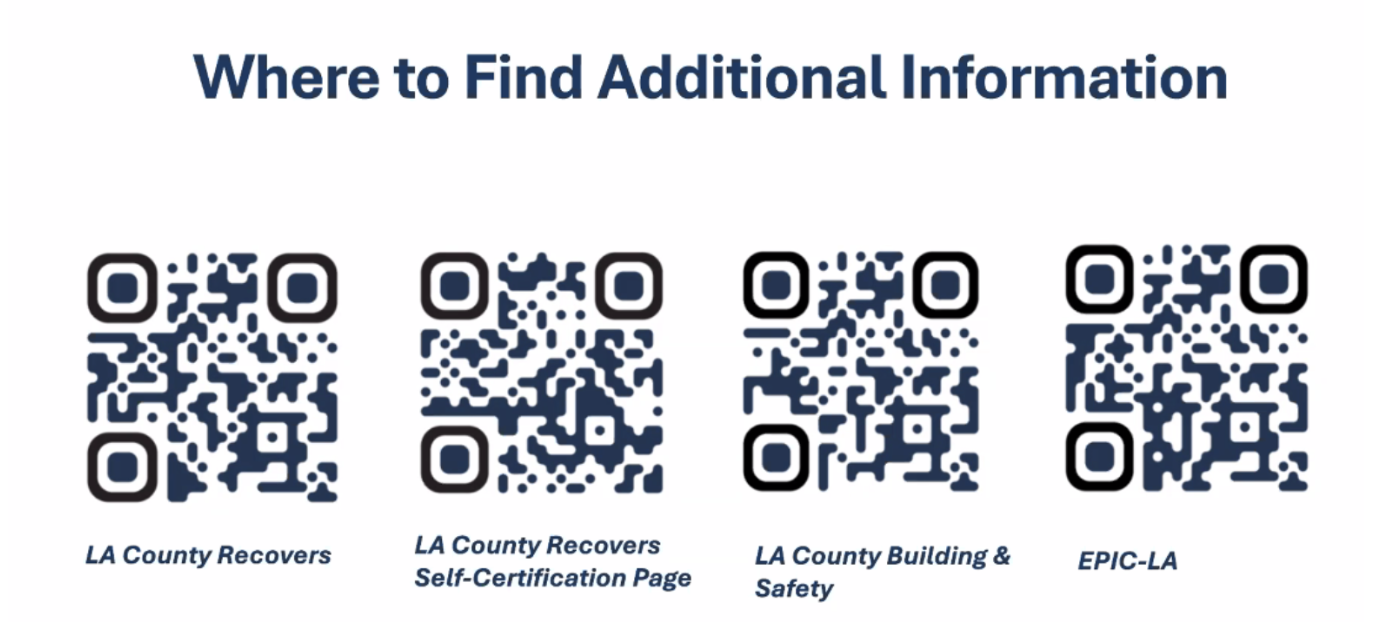
Rebuilding Together Resources: recovery.lacounty.gov/rebuilding archives all rebuild-related workshops, instructional videos, detailed rebuilding guidelines, and an FAQ section.
Progress Dashboard: Available on the recovery.lacounty.gov site, this dashboard updates three times a day, allowing residents to track the overall permitting progress in real-time.
Common Errors Document: A list of common errors and omissions that cause delays is available on the "Policies, Exemptions, and Interpretations" page of the recovery site.
One Stop Permit Centers: https://recovery.lacounty.gov/rebuilding/one-stop-permit-centers/
Permitting process dashboard: https://recovery.lacounty.gov/rebuilding/permitting-progress-dashboard/
Website for what Chief Duvally: https://recovery.lacounty.gov/rebuilding/#1740615629855-65de1702-261b
Rebuild policies, interpretations, and exemptions: https://recovery.lacounty.gov/rebuilding/rebuild-policies-interpretations-and-exemptions/
