
Homelessness Is Now the Defining Risk of the Eaton Fire Recovery and It Is 100% Preventable
Jan 23, 2026
Dear friend,
As we enter Year Two after the Eaton Fire, the most urgent risk facing our community is: homelessness.
According to the Department of Angels one-year survey:
Seven in ten Eaton Fire survivors are still displaced.
Most are running out of housing coverage within the next five months, if they had coverage at all.
By now, more than 1,000 survivors and allies have written to endorse our coalition's urgent housing proposal. Many chose to write directly to Edison International CEO Pedro Pizarro. Here are some of their messages:
“Me and my 2 year old daughter are now living in a tent. Do you know how it feels to be cold and scared?”
“To lose everything you worked 50 years for is beyond devastating. We are homeless now and need help with housing.”
“Folks at Edison need to be fired for causing the fire.”
“I'm a fire survivor with a family of six with small children. We have nowhere to stay and need urgent housing.”
“You hold the key to our current and future stability and health.”
That last sentence captures the moment we are in.
These families are not asking abstract policy questions. They are stuck navigating a world in which corporate responsibility and public policy have not yet translated into something basic: a roof overhead.
Should for-profit companies that repeatedly cause disasters be held liable?
This is the question now confronting California through the bureaucratic-sounding “SB 254 study.”
It didn't arise in a vacuum.
Last September, in the final days of the legislative session, SB 254 was hastily amended and passed, granting shareholders unprecedented protections for utility-caused disasters and shifting massive costs onto ratepayers. The Los Angeles Times described the deal as “effectively a bailout.”
The SB 254 study now underway will determine whether that balance should remain, or whether it has tilted too far toward protecting for-profit electric companies at the expense of public safety and the people living with the consequences of repeated fires.
Until recently, this debate largely took place out of sight.
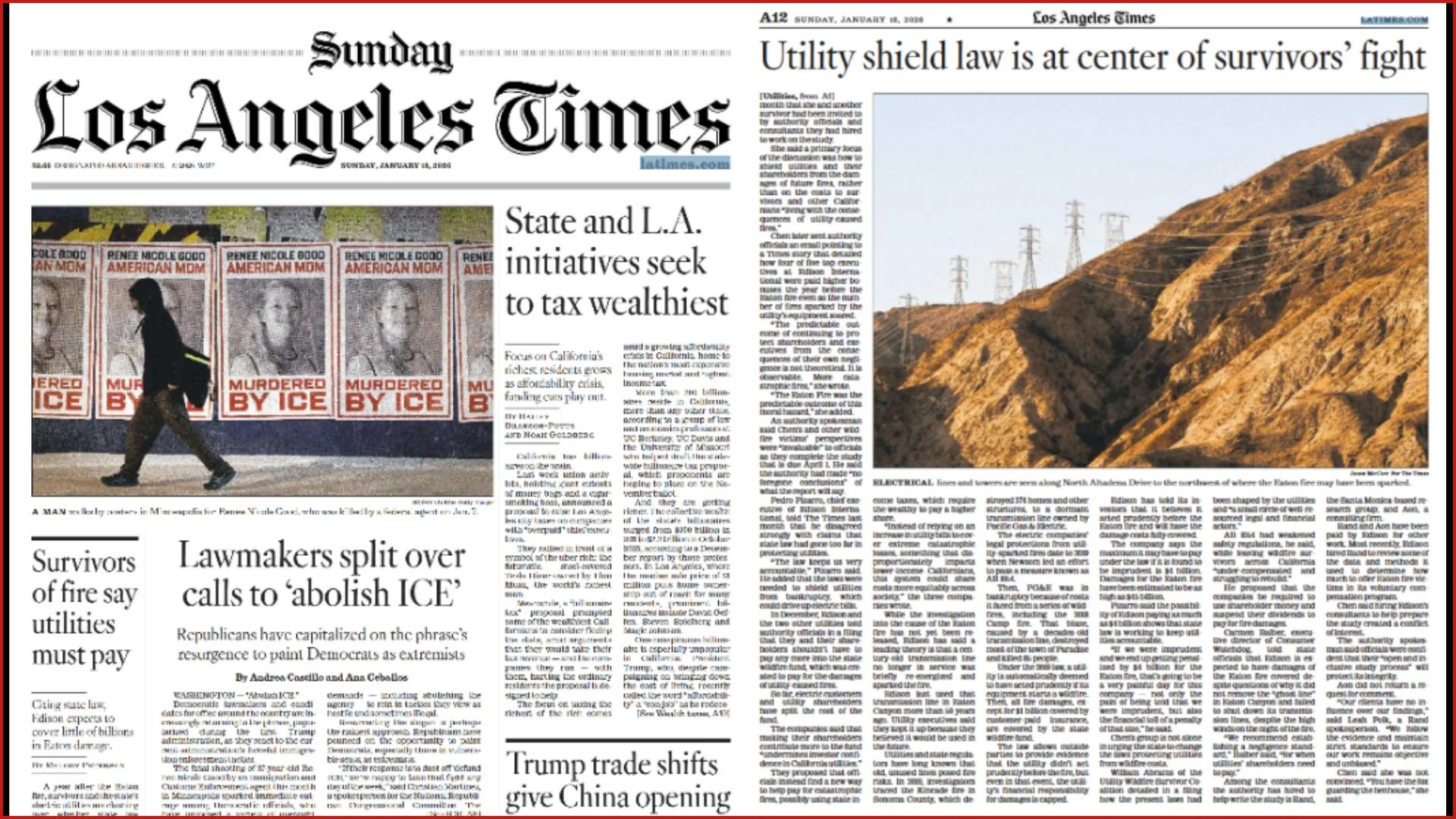
That changed last Sunday, when the SB 254 study appeared on the front page of the Los Angeles Times, above the fold, in a major investigation by Melody Petersen.
The article reported that, as a result of these protections, Edison expects its shareholders to pay little for a fire whose damages have been estimated as high as $45 billion.
When accountability weakens, harm multiplies
After earlier utility-caused disasters, California law explicitly tied executive compensation to safety outcomes. The idea was straightforward: executives should be held accountable when they cause harm.
The front-page LA Times article shows that this accountability failed.
A separate year-long Los Angeles Times investigation by Melody Petersen found that for years before the fires, Edison charged ratepayers hundreds of millions of dollars for “critical and necessary” transmission upgrades and then failed to complete much of that work.
Despite this negligence, and repeated catastrophic fires associated with Edison's equipment, executive bonuses increased. Safety outcomes worsened. The intended link between risk and responsibility failed.
As I wrote in a letter to state officials, quoted extensively in the article:
“The predictable outcome of continuing to protect shareholders and executives from the consequences of their own negligence is not theoretical. It is observable. More catastrophic fires.”
“From a policy perspective, a framework designed primarily to protect shareholders rather than Californians does not safeguard the state. It endangers it. Risk is externalized. Losses are absorbed by families, communities, and the public balance sheet.”
“There is also a foundational legal and economic principle at stake. The principle that underpins private property law and tort law in the United States. You break it, you fix it. Not you break it and your victims pay.”
“Full compensation is not radical. It is the baseline that allows markets to function, risk to be priced accurately, and behavior to change. Loss of housing, health, safety, and community stability are real costs. When they are excluded, they do not disappear. They are simply transferred to victims and to the state.”
“If utilities caused the harm, they must be required to fix what they broke, fully and promptly. Anything less externalizes the cost of failure onto families who did nothing wrong and had no capacity to prevent the damage. That is the shift we are asking for. Not punishment, but accountability. The consistent application of economic logic and the rule of law.”
Read the Sunday front-page LA Times article here: https://www.latimes.com/business/story/2026-01-16/wildfire-victims-decry-state-law-protecting-utilities-from-cost-of-disasters-they-cause
You can read my full letter to state leaders here:
A for-profit monopoly, shielded from consequence
One thing I appreciated about the Los Angeles Times reporting is reporter Melody Petersen's consistent use of clear language to describe Edison: a for-profit electric company.
That precision matters.
Edison is not a neutral public utility. It is a monopoly. Its costs are borne by ratepayers. Its profits are owned by shareholders and executives.
In October, Edison reported a whopping 61% year-over-year profit increase, driven by a major rate hike approved by state leaders. The results far exceeded Wall Street expectations, with CEO Pedro Pizarro crediting regulatory protections for the company's unusually strong financial performance.
So who is funding these soaring profits and unprecedented state protections?
Ratepayers.
Many are the same families whose homes were destroyed by Edison's negligence, and who are now facing housing instability and homelessness as a result.
What this means on the ground, right now
Against this backdrop of statutory protections, liability caps, and ongoing policy debate, the lived reality for displaced families is clear:
The homelessness crisis now unfolding is fully within Edison's control.
What makes this especially painful is that Edison is not a distant corporation, but a hometown company headquartered right here in Rosemead, California. It's part of the same community where displaced families struggling to keep a roof overhead.
This homelessness crisis is fully preventable. Edison can seek reimbursement from the Wildfire Fund for 100% of any urgent housing costs it advances. Survivors are not asking Edison to pay for housing. We are asking the company to advance the funds needed to keep families housed so that recovery can actually begin.
Every other for-profit electric company in California has advanced urgent housing relief after fires they caused. Only Edison has not.
This call is supported by a broad civic coalition of more than 250 nonprofit and philanthropic organizations, along with faith leaders, neighborhood groups, and community institutions across Southern California. We share a simple conclusion: Edison should follow the lead of its peers and advance urgent housing funds so that families whose homes were destroyed can keep a roof overhead while they fight to get back home.
If you see Edison executives or board members in the community, or know them personally, please urge them to act now. Stopping homelessness is the fastest way to stabilize families and move the Eaton Fire recovery forward in earnest.
The coalition's urgent housing proposal is here: edisonrelief.org
Beyond Edison, insurance is the next driver of homelessness
Edison is not the only institution shaping housing outcomes right now.
The next major driver of displacement and homelessness is insurance.
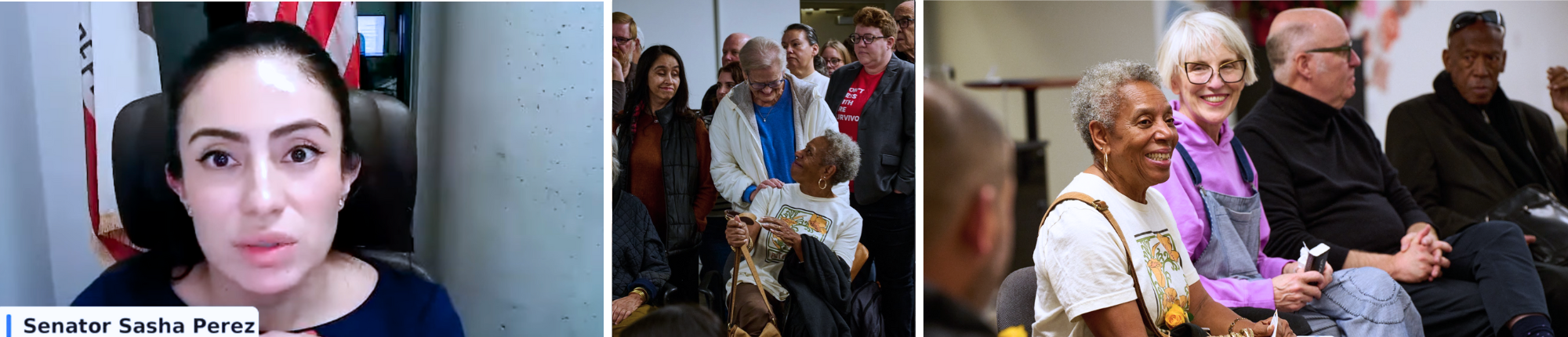
This week, we hosted a powerful town hall with Senator Sasha Renée Pérez focused on two insurance reform bills she has authored to address enforcement failures, transparency gaps, and prolonged delays that are destabilizing families across California.
According to Department of Angels research, 70% of insured Eaton and Palisades fire survivors report that delays, denials, and underpayments are actively derailing their recovery. These are widespread patterns with direct consequences for housing stability.
SB 877 requires insurers to disclose all original loss estimates and all subsequent revisions, allowing policyholders to see how their losses were calculated and to verify what is being presented as fact.
SB 878 adds automatic penalties when insurers violate existing payment deadlines, removing the financial incentive to delay and helping stalled recoveries move forward.
Organizational endorsements are especially important right now. The insurance lobby is one of the most powerful in Sacramento, and these bills will only move if a broad, visible coalition stands behind them.
If you are affiliated with a nonprofit, faith institution, neighborhood group, or community organization, or if you are speaking only for yourself as an individual, your endorsement matters.
You can read more, add your name or your organization, and watch the Senator Pérez town hall here: payclaimsontime.org
Why such basic things we are owed are so hard to get
By now, you might be thinking: survivors are not asking for anything radical.
We are asking that the same basic standards the rest of us live by be applied here.
That when a private company causes harm, it is responsible the harm it caused.
That Edison do what every other for-profit electric company has: advance urgent housing relief so families it displaced are not pushed into homelessness.
That insurance companies pay what they owe, on time, based on factual and transparent loss estimates.
These are ordinary expectations.
So why has this been so hard?
Because the for-profit electric company lobby is one of the most powerful in Sacramento.
And the insurance lobby is another.
Both are deeply resourced and present at every step of the process.
Survivors are not.
We have no lobbying teams or PR firms. All we have is our lived experience, pattern recognition, and one another.
Only when we come together — analyzing policy, documenting misconduct, finding patters — do patterns become undeniable.
And only when we make these patterns public does public policy have a chance to respond in ways that protect not just survivors, but every Californian who pays insurance premiums, pays taxes, and expects the protections they were promised.
All we are doing is building coalition with our allies around common-sense principles so the billions already owed can begin to move, and families are not forced into homelessness while recovery stalls.
That is the work as we begin Year Two.
And that is why being together matters now.
Grateful thanks
We are pouring our hearts into this work, and I am deeply grateful to those who have stepped in to sustain it.
While I've spent more than 30 years in global business, media, and public policy, this is my first time leading a nonprofit. I'm learning quickly how much of this work depends on fundraising just to keep the lights on.
Honestly, fundraising has been the hardest part.
That's why this week meant so much to me. A five-figure anonymous donation arrived - if that was you, thank you.
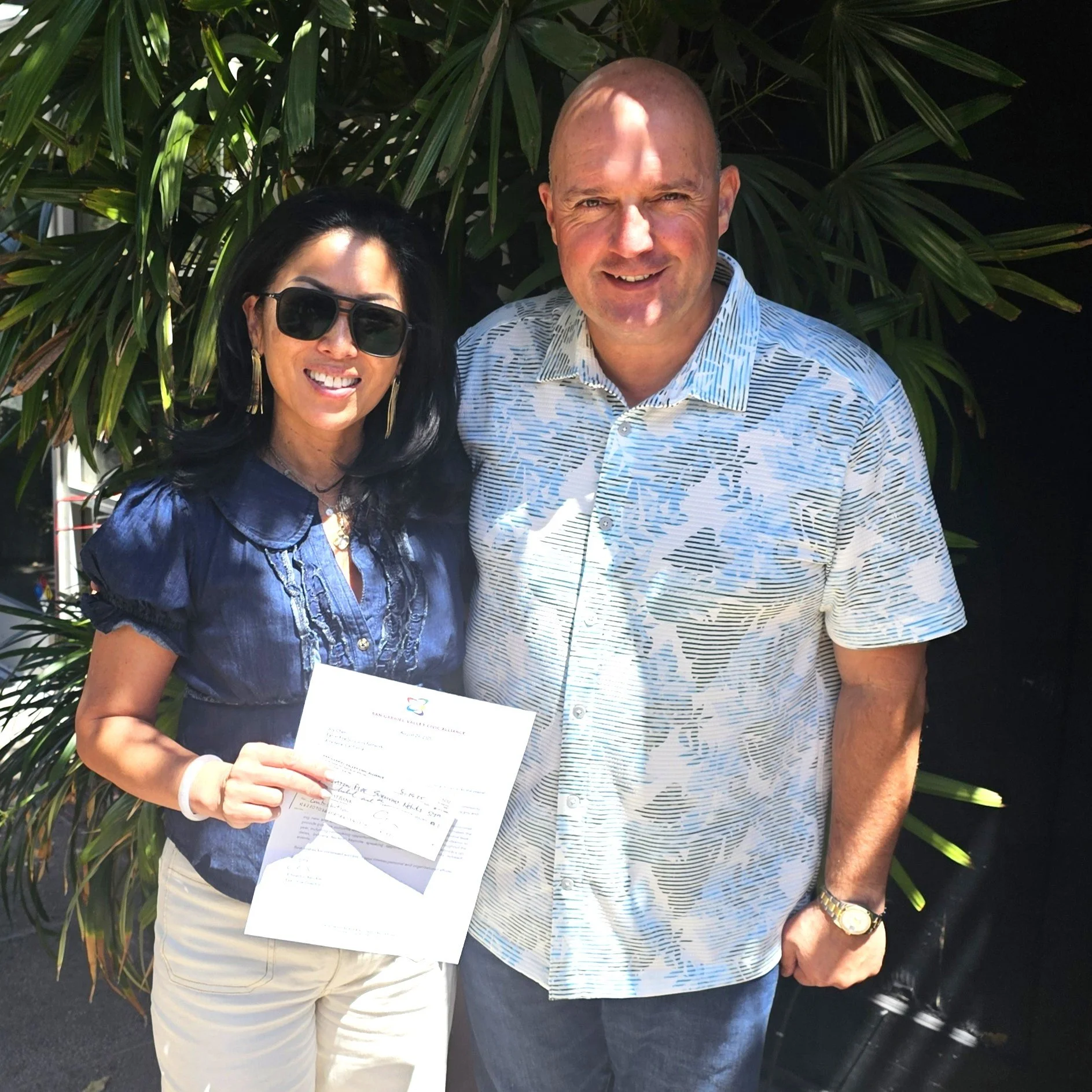
And my longtime friend Ed Rendon, appeared and surprised me with a generous gift to EFSN.
Support like this helps keep me going as we build, together, the coalitions needed to ensure that recovery is not reserved for the wealthy, but available to everyone.
If you feel moved to donate, whether $5 or $1,000, you can do so here:
https://fundraise.givesmart.com/e/s2Cq0w?vid=1oblrf
With love,
Joy
P.S. If this newsletter resonated with you, please share it. Every new survivor and ally strengthens us all.
The Eaton Fire Survivors Network (EFSN) is a survivor-led recovery hub of more than 10,000 Eaton and Palisades fire survivors and allies, organizing at scale to unlock the billions already owed so that recovery is not reserved for the wealthy, but available to everyone.
